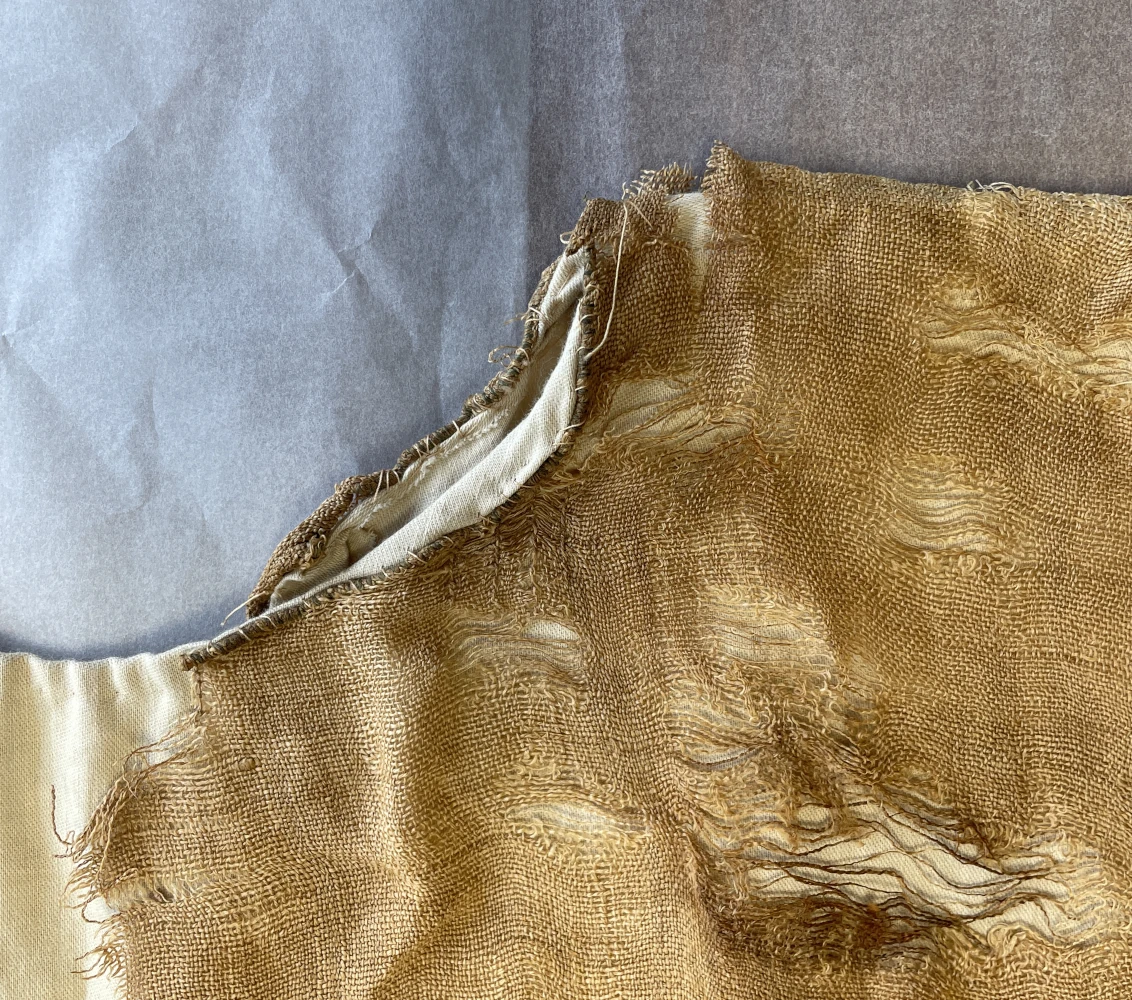

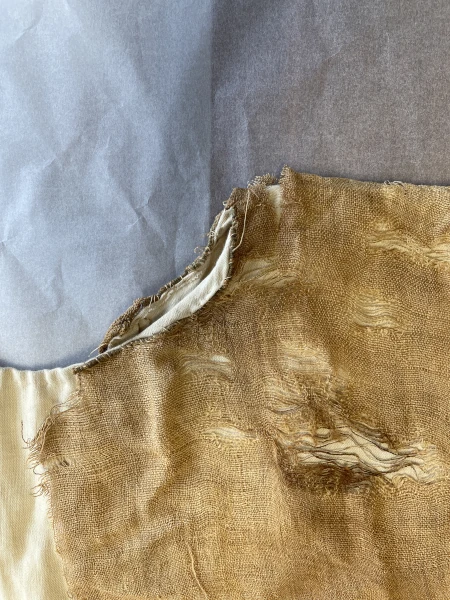
June marks a farewell to a piece that has been in and out of our studio for almost three years, an ancient Egyptian tunic from West Berkshire Museum. Conservator Tabby shares her account of this special project.
The Tunic
The tunic arrived in September 2023. Everyone in the studio gathered round excitedly when Zenzie returned from her first visit to West Berkshire Museum. We so rarely have the privilege of working on textiles quite this old, let alone pieces this large and with such a remarkable history.
The tunic was originally excavated by Howard Carter and Lord Carnarvon, who gifted it to West Berkshire Museum in 1909, some 13 years before the pair’s best-known discovery, Tutankhamun’s tomb. It was found alongside clothing in the tomb of Irtyru, who died in the Third Intermediate Period (c.800 BC.). It is an example of an ancient Egyptian bag tunic, and one of the things that makes it so fascinating, is that it is a piece of everyday clothing, rather than something that would have been worn by the wealthy. This type of insight into the daily life of an average person, is something which does not survive as frequently.
It is linen, plain woven in one length and joined at the sides. It has cut out neckline which is finished with a rolled hem, and there are holes left for the arms and, rather amazingly, what appear to be pocket openings. There are areas of couched stitching lines which research suggests could have been used to give shape to an area, although it is more likely that for this piece, they were used to give reinforcement to areas most liable to heavy wear and thinning, providing the dual function of a decorative design feature. The sides and bottom hem have selvedge edges with strips of indigo dyed blue, with the bottom hem also featuring fringing
First Stabilisation and Display
Tabby originally undertook a minimal treatment to stabilise the tunic ahead of its 2023 display. The work focused primarily on creating a supportive pad on which to display it flat, netting the most fragile areas, and repositioning the neck opening, which had been pulling against previous repair stitching. It was then displayed for a year as part of the museum’s From the Nile to Newbury exhibition.
We were delighted when, after the exhibition closed, the tunic returned to us, which gave us the opportunity to carry out further work in preparation for long-term storage.
Further Conservation
Working closely with the museum’s curators, we sought to better understand the fragments that had been pieced together into a tunic for display some decades ago, fragments which may not, in fact, be from the same garment. We thought carefully about how best to interpret and present them through the lens of this new conservation. Ultimately, it was decided that both pieces would be remounted on the same new support fabric, with a small gap of a few centimetres between them, inviting viewers to consider the possibility that they were once two separate tunics.
Tabby carefully removed the previous light-coloured cotton support and replaced it with a more sympathetic linen. The moment the old support came away, the tunic seemed to relax instantly, it was as though it had been holding tension for years and could finally breathe.


The closest match of fabric in weave and texture to the original tunic was, unfortunately, a light pink linen, which made dyeing it to the correct colour considerably more challenging, although after several samples the final colour was achieved which captured a good middle ground between the varying beige and brown tones present in the tunic. See the photo below for some stages of sampling these.


Once the correct colour was achieved, Tabby was able to construct a support fabric, that would mimic the shape of the original tunic, so when the pieces were mounted on top, viewers would be able to imagine how the tunic would have appeared when it was a whole garment.
The top and bottom half of the tunic were gently humidified, not to remove any evidence of historic creasing, but to reduce the harshest lines and creases from storage, and to allow them to sit flat on the new support. Once positioned, they were safely secured in place, with lines of couched support stitching and custom dyed net overlays used to give added protection to the most at-risk areas. One element of additional research was carried out into the necklines of ancient Egyptian bag tunic necklines, this was necessary as a new neckline had to be constructed in the new insert, and the shape was slightly altered to fit the new shape uncovered when the weave was aligned by conservation. As there is no centre seam in the majority of bag tunics, it would have been difficult to create a true v-neck shape without a facing. Most bag tunics have a rolled edge over a cord, which sometimes led to a drawstring fastening. This results in a final shape of a rounded, keyhole shaped opening lifted up slightly to match the location of the armholes.
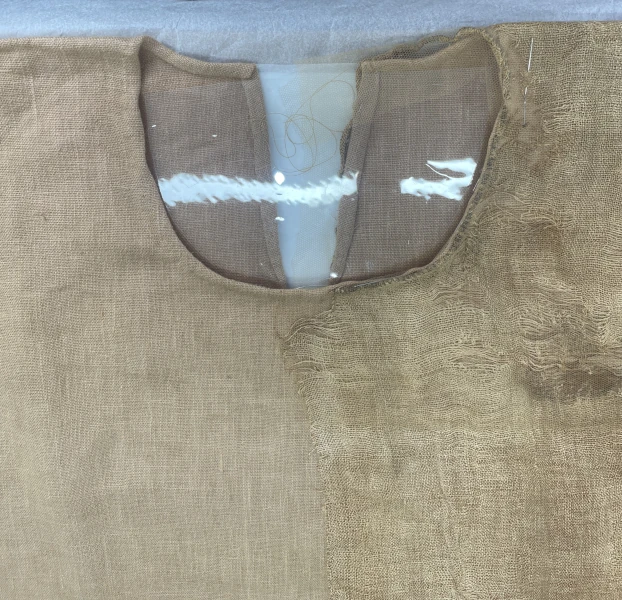
Now finished, the tunic is safe for many years to come, it can go happily into long term storage, and the museum will have the option to easily access and display the tunic as it is, or even potentially on a mannequin, in the future.
After the top tunic fragment was attached, Tabby went on maternity leave. On her return in April 2026, she was struck by how effortlessly she picked the project back up, she was so familiar with the piece that it felt as though no time had passed at all. She is grateful to the museum, and to Zenzie, for the opportunity to see it through to completion. As textile conservators, we often find ourselves lost within fibres, and this project was one in which Tabby was particularly invested.
An exciting development during her absence was that the museum had acquired another selection of linen pieces from the same grave context. Sadly, on investigation, it seems unlikely that any of them directly relate to this tunic.


A Poem Inspired
Poet Alex Josephy visited the studio while Tabby was working on the tunic and was inspired to write a poem in response. Her image of “a woven bridge […] opened into the vanished past” is particularly beautiful, and we are delighted that she has given us permission to share it on our website.
An Ancient Egyptian Tomb Cloth
Unfolded in a Brighton loft,
an afterlife. Not of fine stuff,
more like a rag torn from a garment
used beyond wearing, repurposed
as a noblewoman’s comfort
in that long waiting silence.
Flax strands eroded to a golden buff,
all it had to offer was threadbare warmth,
a breath of nature beyond
the blank stone door of the dead.
It huddled close beside the mummy,
wedged in tight to hold her still
against earthquakes, raiders,
or to absorb the distant vibrations
that rocked the centuries.
Conservators peck at its margins
under cold north light, tease out
a blue selvedge, a tattered fringe.
Fragments of neckline, hidden slit
for a pocket; it’s a servant’s tunic.
They don’t try to fill gaps,
and can’t heal it, darkly stained
by balsam: the indistinct outline
of five splayed toes.
An embalmer’s footprint.
Here’s no resurrection,
but a woven bridge has opened
into the vanished past; a mistress
who thought herself immortal
and her forgotten maid.
By Alex Josephy
Saying Goodbye
There is something extraordinary about handling a textile that has survived more than two and a half thousand years, and we feel privileged to have played a small part in ensuring it survives for thousands more. But we have said goodbye for now, carefully packaging the tunic inside its (very large) acid-free, long-term storage box, before making its journey back to the Museum.
If you’d like to find out more about the museum and its Egyptian collection, you can visit their website here.

