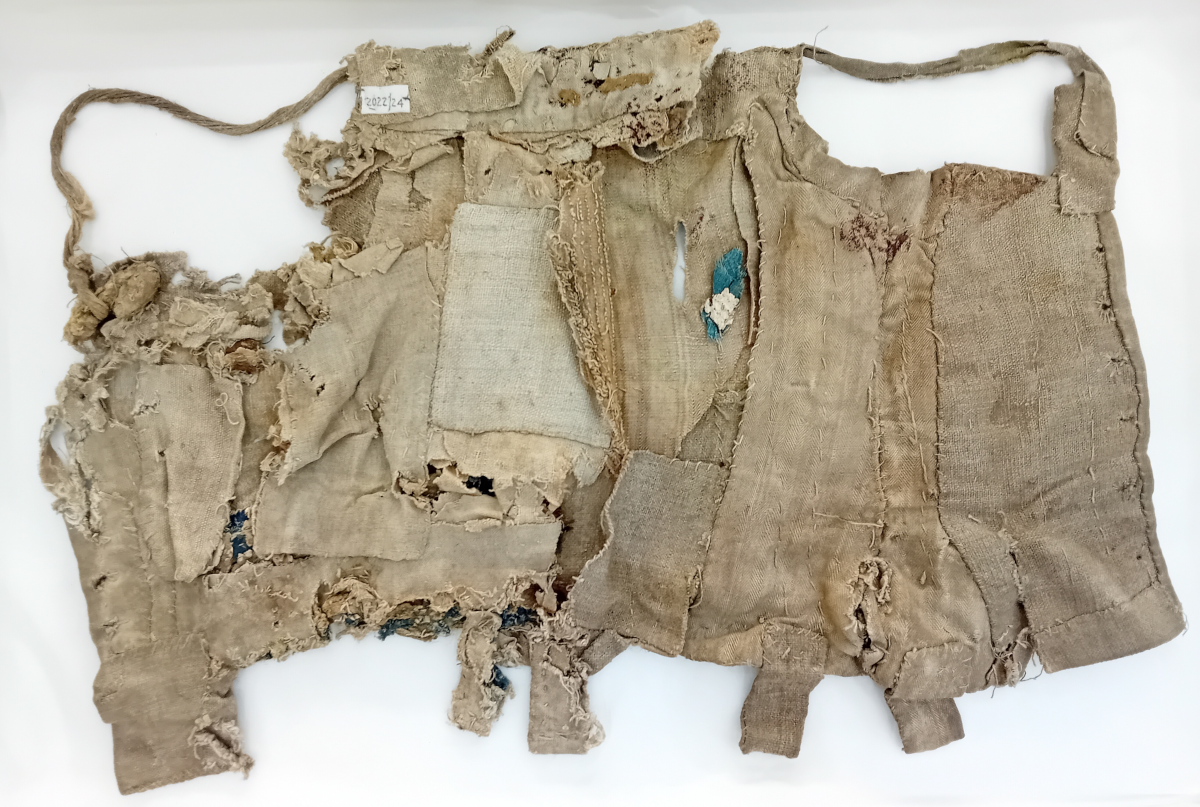

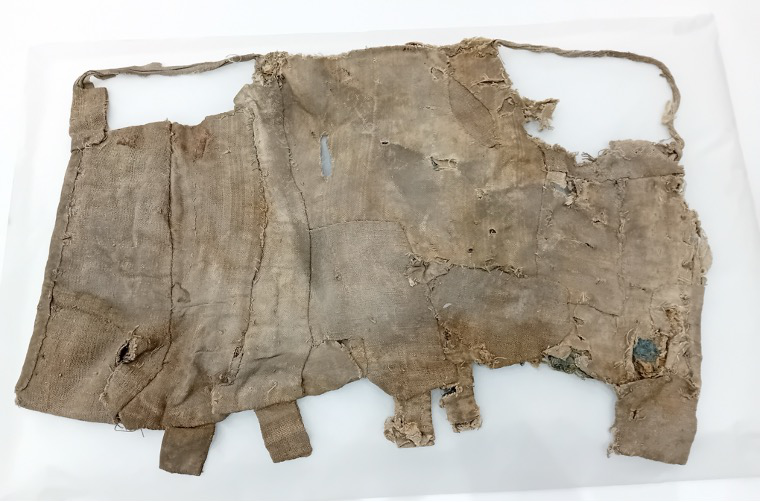
In 2022, during renovation work at the former Henfield workhouse, a remarkable textile object was discovered tucked into a corner of the eaves: a heavily worn and repeatedly altered pair of stays, or bodices. The building dates from 1735-6, although the date of the garment itself remains uncertain. Its location also raises an intriguing question. The stays may have been deliberately placed within the structure as a “concealed object”, but they could equally have been used pragmatically to block a draught, or simply have been lost or abandoned within the building.
Henfield Museum brought the stays to Zenzie Tinker Conservation for condition assessment, investigation and the development of a conservation and display strategy. At first sight, their significance lies partly in their survival at all. They appear to represent a rare example of everyday women’s clothing from a relatively modest social context: not a pristine or fashionable garment preserved because of its beauty, but something intensely used, repaired, altered and retained for as long as possible.
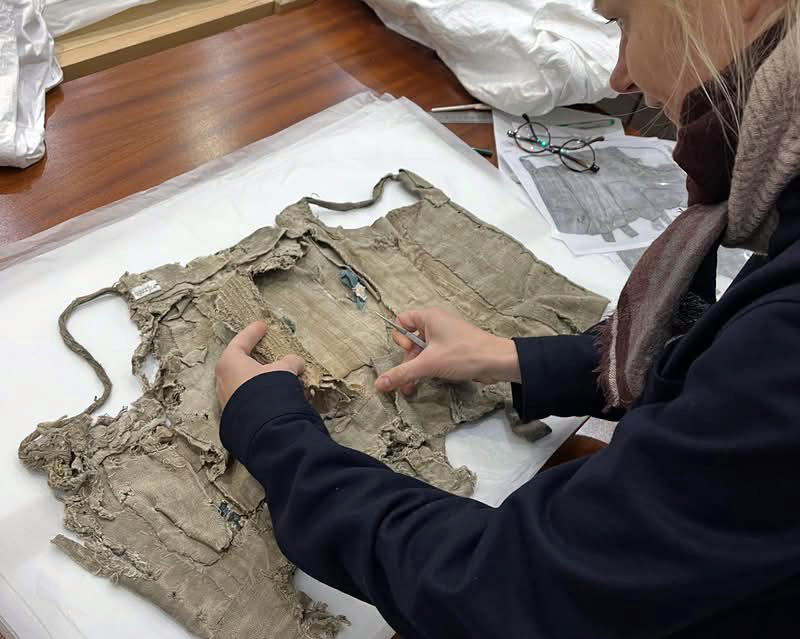
Reading the construction
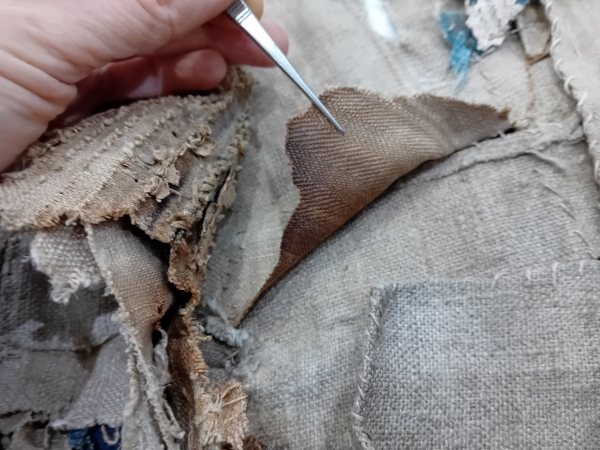
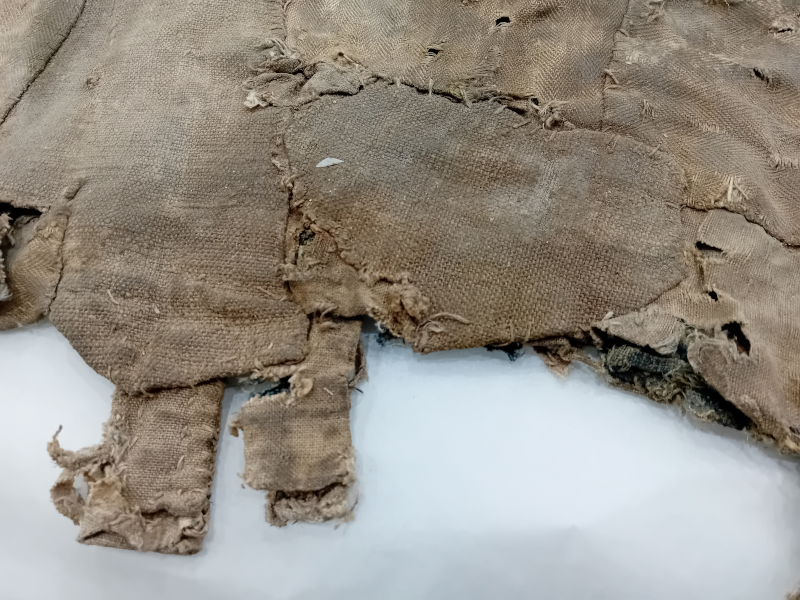
The garment is principally made from several different linen fabrics. Much of the outer surface consists of a heavy, naturally coloured herringbone-weave textile, with additional fabrics employed in the lining, patching and later alterations. The centre-front opening retains six worked eyelets on either side, while surviving skirt or waist tabs, repaired shoulder straps and numerous stitched seams help preserve something of its original construction.
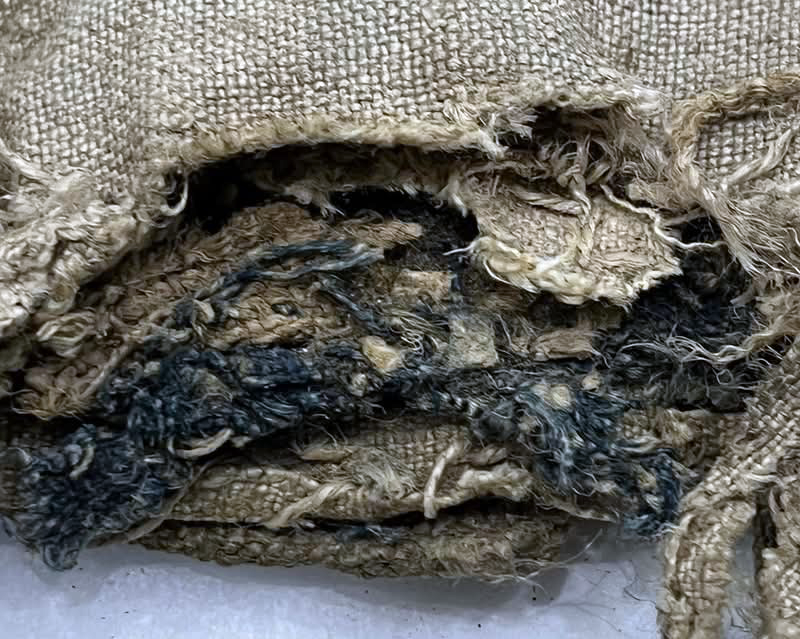
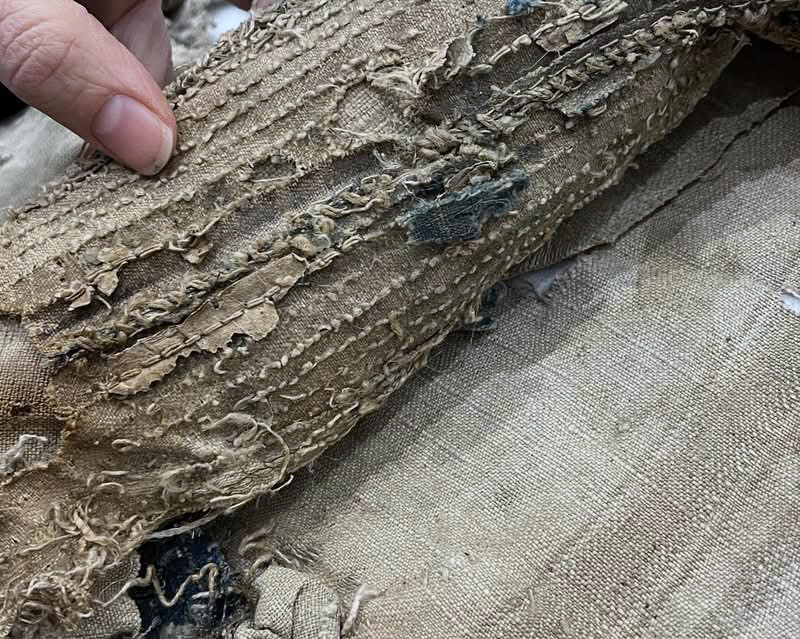
Its internal structure is particularly revealing. Narrow stitched channels survive within the layered construction, together with very small fragments of dark baleen. Other areas include fragments interpreted as cardboard and/or parchment, alongside several layers of fabric. Such evidence indicates that the stays were originally structured more substantially than their present collapsed appearance might suggest. A pair of children’s stays were discovered under the floorboards of Walnut Farm in Dorset with some similarities in construction which proved useful as additional reference material.
The exterior is comparatively coherent, although heavily soiled and worn, while the interior exposes the complex accumulation of patches, linings, channels and repairs that makes the garment so valuable as evidence of use.
Repair as evidence
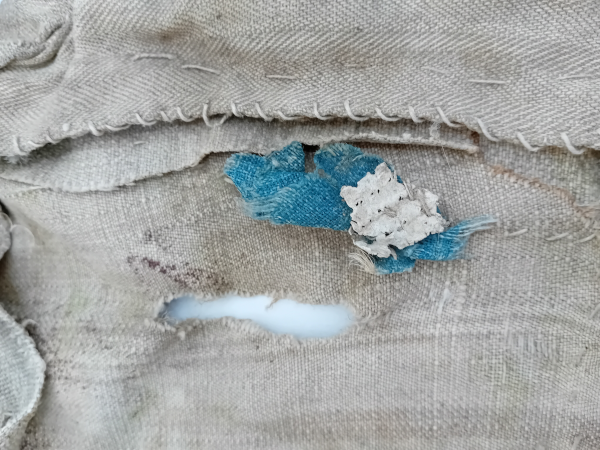
Rather than regarding the extensive repairs as secondary damage or disfigurement, they can be understood as one of the most historically informative aspects of the stays. Multiple patches occur on both the inside and outside, and several different fabrics appear to have been introduced over time. The evidence suggests a garment repeatedly modified to extend its useful life. Indeed, the surviving object may itself incorporate elements of an older pair of stays that were recycled, handed down and altered.
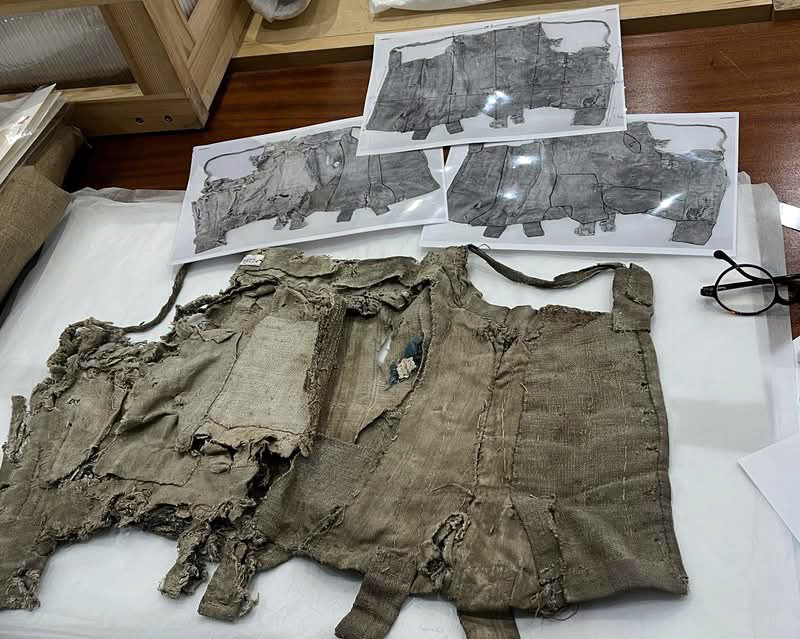
There is also evidence of more dramatic episodes in its working life. The lower part of the back has been burnt away, yet subsequent patches and lining materials appear to cover some of the fire-damaged areas. This strongly suggests that the garment continued to be used, or at least repaired, after the incident.
The front also seems to have been adapted by cutting splits into both sides, apparently creating additional space for the wearer. The present asymmetry may be the cumulative result of such alterations, prolonged wear, repeated patching, the shape of the wearer’s body and, later, environmental distortion after abandonment.
One possible interpretation raised during preliminary discussion is that some of the garment’s asymmetry or padding could relate to an individual wearer’s body shape, perhaps even an attempt to accommodate spinal curvature. At present, however, this remains a hypothesis rather than a firm conclusion, and further specialist study of historic stay-making and dress construction would be needed before such an interpretation could be substantiated.
Condition and the archaeology of wear
The stays arrived in poor condition, affected both by their working life and by the environment in which they were subsequently concealed. They had been partly eaten by rodents, while damp conditions had contributed to deterioration of some fibres. Their exterior was also heavily contaminated with embedded mud and particulate soiling, making the textile stiff and obscuring constructional details.
Microscopic examination identified black spotting on the lining layers that appeared potentially consistent with active mould at the time of assessment within the already degraded textile layers. Together with tears, worn eyelets, fragmentary straps and areas of biological damage, this made handling especially hazardous.
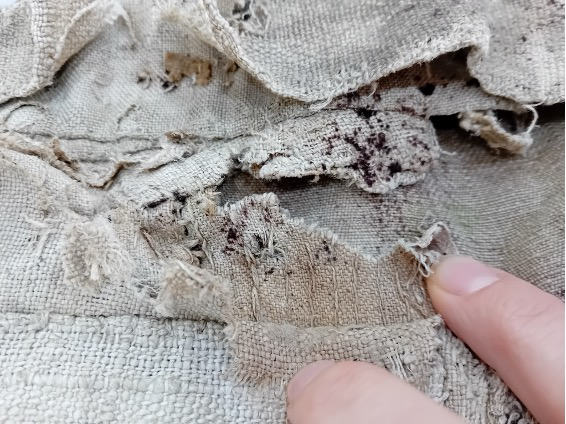
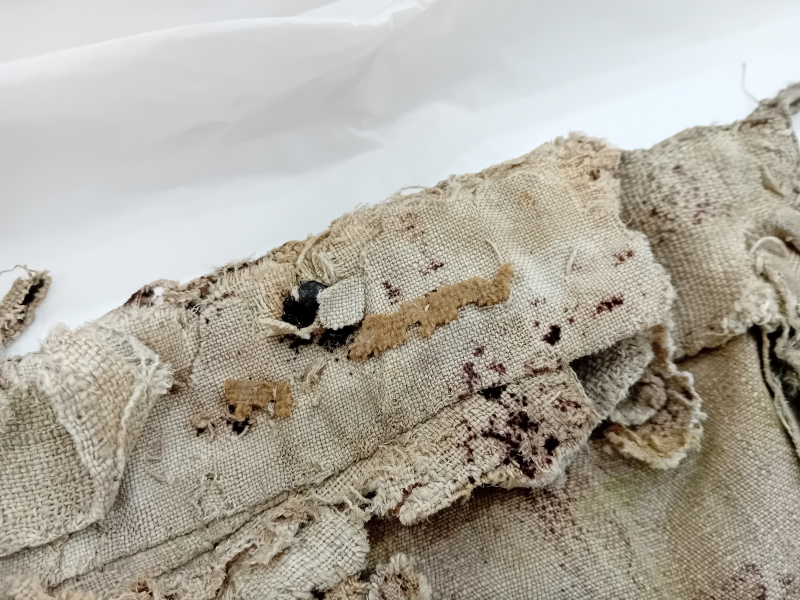
Yet many of these apparent “problems” are also part of the object’s historical record. Abrasion reveals repeated use; patches document repair; missing boning exposes construction channels; and alterations preserve decisions made by previous owners or makers – material that records its history.
Conserving without erasing
For this reason, our proposed approach was deliberately restrained. The aim was not to return the stays to the appearance of a complete garment, nor to disguise their fragmentary condition. Instead, conservation would stabilise the surviving materials while preserving the layers of alteration, use and damage that make the object so informative. Our treatment proposal recommended thorough documentation, controlled surface cleaning, treatment of possible active mould and gentle relaxation of distorted folds and edges so that the garment could be examined and understood more clearly.
We also recommended consultation with an expert in working garments and historical dress construction at the Historical Costume Society which is where Henfield Museum eventually decided to deposit this garment.
Why this object matters
Objects such as the Henfield stays can be difficult to interpret precisely because they do not conform to the neat categories often favoured by museum collections. They are damaged, altered, incomplete and materially ambiguous. Yet it is precisely these qualities that make them unusually eloquent.
The stays preserve not one moment of manufacture, but a sequence of decisions: construction, wear, adjustment, repair, damage, further repair, abandonment and eventual rediscovery. Their mismatched textiles, patched linings, worn eyelets and scorched areas point towards an economy of clothing in which garments could be altered repeatedly and materials reused rather than discarded.
Conservation in this instance is therefore as much about enabling investigation as preventing further deterioration. By stabilising the object without tidying away its complexities, we hope to preserve the physical evidence from which future specialists can continue to ask questions.
The Henfield stays may never yield a single, definitive account of their date, wearer or reason for concealment. What they do preserve exceptionally well is something perhaps more elusive: the material history of a garment that was used hard, adapted repeatedly and considered worth repairing again and again.
You can read the story of The Henfield Stays in an article written by Stephanie Richards, Curator of Costume at Henfield Museum.