
Stephanie Richards, Curator of Costume at Henfield Museum
On the evening of the seventh of December 2022, the Friends of Henfield Museum Christmas tea was in full swing in the Henfield Hall.
As the evening drew to a close, Alan, the museum curator, told me that an item had been dropped off at the museum a few days before and would I please take a look at it before I went home? Not an unusual request. But it was to prove a very unusual item. I had no idea that when I left the building that night, I would be carrying a bundle of filthy fabric wrapped in a paper tablecloth.
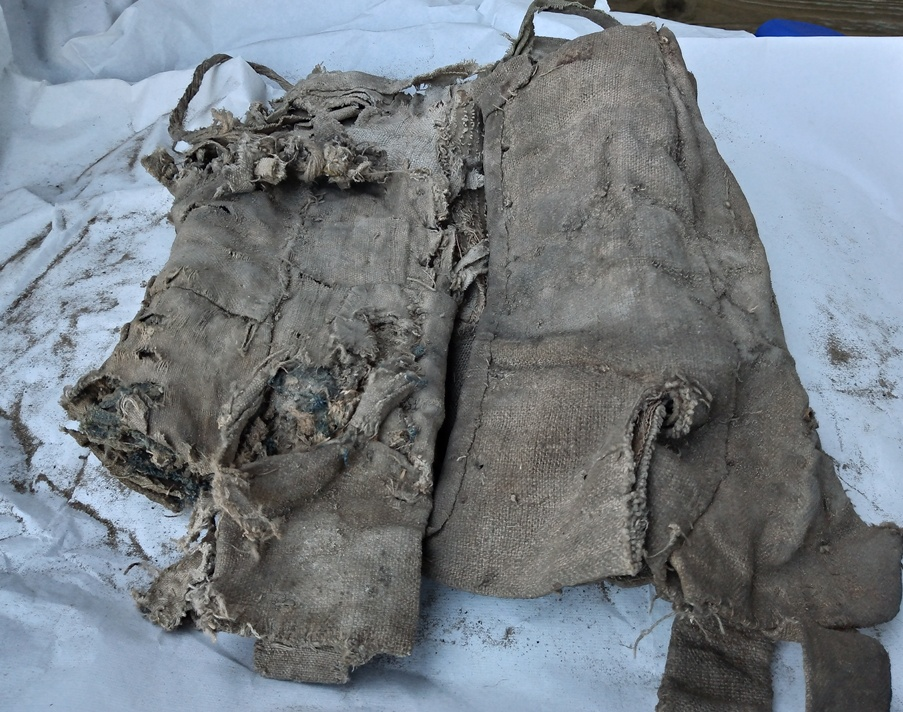
In the museum I found a small bundle of very dirty cloth lying on a chair. It had been brought in without a bag. Very carefully I picked it up and looked at what appeared to be a bodice shape. It was saturated in dirt that was so fine it ran from the bodice like water. In the absence of anything else suitable, I requisitioned one of the (clean) paper tablecloths from the tea tables and wrapped it up like a bundle of washing. All I had to go on was the accession form which had ‘In loft’ written on it. Anymore would have to wait for daylight. And gloves.
The first time I examined the stays in daylight my diary reads ‘Shook out loft find donation to try and get some of the dirt out. Appears to be a corset/stays. A very old one.’
I had carefully unwrapped the stays outside, as I had no idea whether anything was alive in there. Thankfully not. The dirt was mostly dry mud and general grime. No odour and no frass. Previous visits from a rodent had wreaked havoc on one side of the stays.
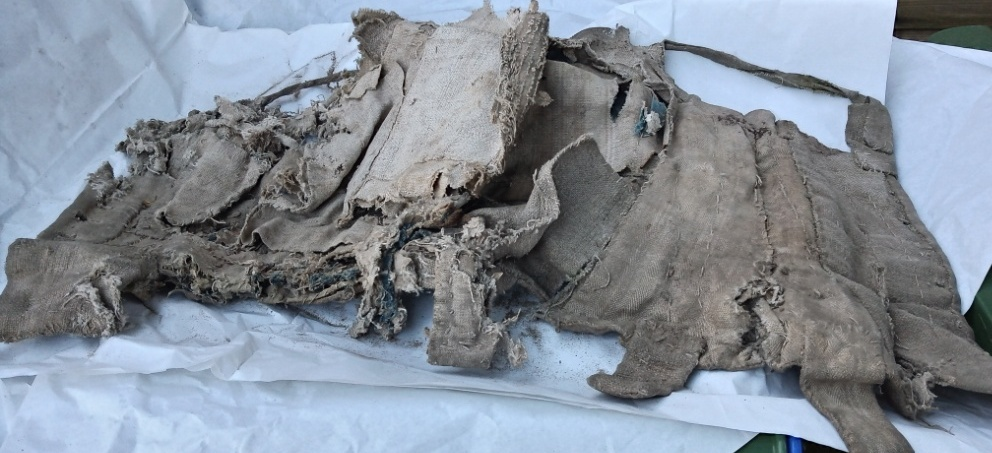
The stays were largely made up of patches. Patch upon patch. Linen, twill, hessian and something dark blue with a white pattern. There were four tabs at the waist and another that was either patch or tab. They were in a mixture of materials. Vestigial ridges of what looked like boning channels were in there as well. The lacing holes were intact on one side and the thin straps both still in place.
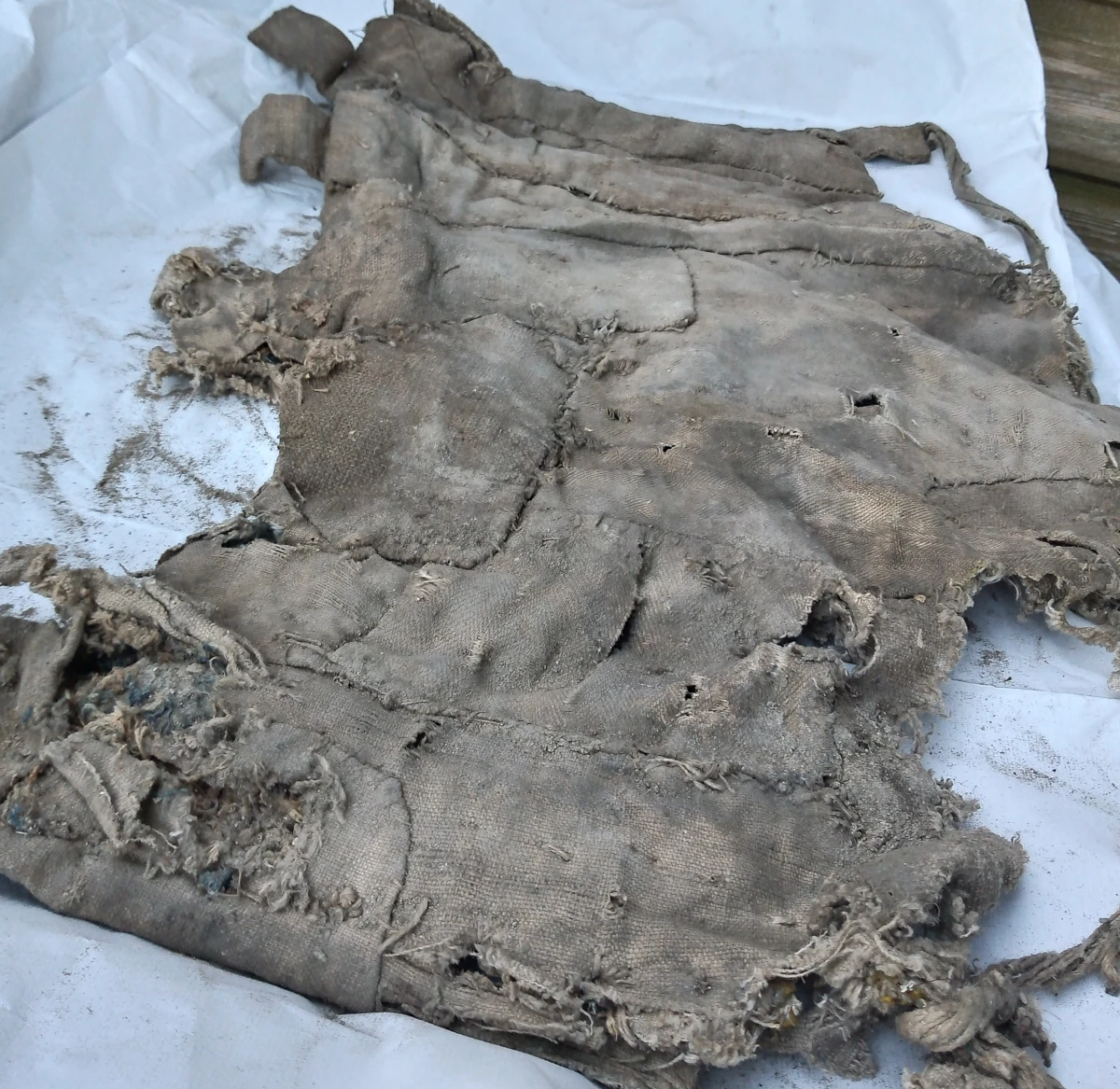
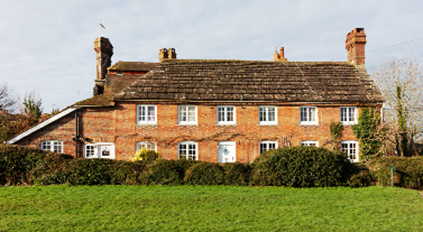
A few days later I had a telephone conversation with the donor who told me that the stays were found in a corner by the eaves of his house when he had had the ceilings down to expose the beams. The pile of cloth he found was so covered in dry mud and hair from the lath and plaster construction of the space, he took it to be a rag and his wife advised him to throw it away. But he decided to bring it to the museum to make sure. Thank goodness.
The house where the stays were found was built as Henfield Workhouse in 1735/6. It closed in 1835, when the inhabitants were sent to the Union Workhouse in Shoreham by Sea.
The building is now four homes and was Grade II listed in March 1955. Over time other concealed objects have been found in different parts of the building; a mummified cat and a bird and a portion of a sheep skull. The stays are the first garment to emerge. Having removed as much of the surface dirt as was safe to do without compromising the piece, I wrapped it in acid free tissue and stored it in a secure box. I needed to find out whether anything live would emerge. Happily nothing did.
So, with the stays safe and boxed, next on my agenda was to explore whether these could have been a deliberately concealed garment. I was extremely lucky to have Dr Dinah Eastop visit Henfield and look at the stays for me. She has a wealth of knowledge and experience in this field. Her summing up says it all really ‘they have seen a lot of service’.
It is impossible to know whether the stays were deliberately concealed or not. They might have been kept as a pattern, or used to stuff into a rat hole or perhaps stolen and hidden and forgotten.
The stays were displayed in the museum for a period, but I recognised that conservation and stabilisation had to be addressed.
Who better to talk to about this than Zenzie Tinker?
After I made contact with Zenzie some emails and photographs of the stays were shared and a meeting arranged at her Brighton studio. She and her staff could not have been kinder; from offering to assist with carrying the stays in to the building to the cup of tea I had there.
I made sure to take with me a history of the workhouse building where they were found, samples of the dirt that had come out of the stays and some fragments of the boning channels that had become detached. I knew I had something special, as some of the conservator staff Immediately gathered round to have a closer look. Zenzie made the point that they were working stays, so even more interesting, as not many utilitarian garments still exist. Her suggestion that the School of Historical Dress would no doubt be interested in seeing them proved very perceptive.
The subsequent report on the stays produced by Zenzie Tinker Conservation was comprehensive, detailed and fascinating. (I had never realised that there were burn marks on the back despite peering at them for hours) .
So, after a few friendly emails back and forth between Professor Jenny Tiramani, Head of the School of Historical Dress, Zenzie and myself, the arrangements were finalised. The School of Historical Dress would take the stays and add them to their prestigious collection. It was a wrench to lose this fascinating piece from the costume collection at Henfield. But by their very uniqueness, they needed to be in a bigger collection where they could be stabilised and conserved as needed. So, four years after first seeing a sad heap on a chair, I was able to complete the exit paperwork for the Henfield stays to go from Henfield Museum to their new home in the School of Historical Dress.
The stays now take their place in the School of Historical Dress collection. In this, their new home, they are amongst their peers and available for study and teaching. Prof Tiramani put it perfectly; ‘We are absolutely enchanted by the stays. They have so many features which are important for us to teach with (and to learn from ourselves). The number of different textiles in them alone is an object lesson!’
This has been one of the most interesting pieces of costume that I have ever researched handled and I am so pleased that it is now at home amongst friends!
Grateful thanks to:
- Alan Barwick, Curator Henfield Museum
- Zenzie Tinker, Director and Lead Conservator, Zenzie Tinker Conservation Ltd
- Professor Jenny Tiramani, The School of Historical Dress
You can read more about the discovery of the Henfield Stays on the Henfield Museum website or take a closer look at their conservation journey in our blogpost, A Garment In Layers: Investigating the Henfield Stays